
Professional standards · Guidance
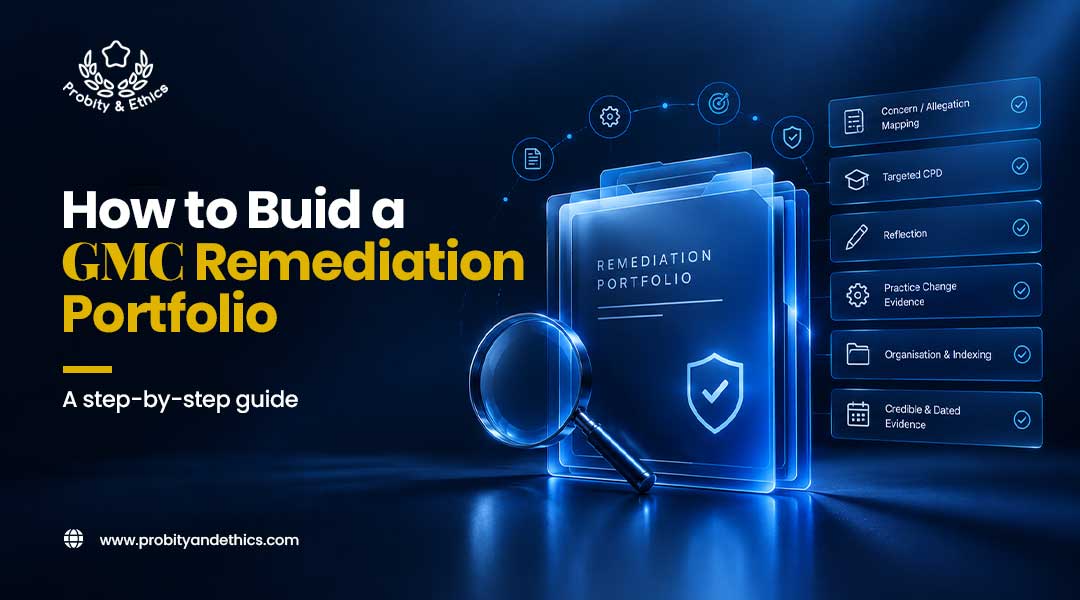
How to Build a GMC Remediation Portfolio That Convinces Case Examiners: Step-by-Step Guide
Your GMC investigation letter has arrived. A vague apology and a handful of unrelated CPD certificates will not protect your registration. What case examiners and MPTS panels need to see is a GMC remediation portfolio: a structured, indexed bundle of evidence proving you have understood the concern, acted on it, and that it will not recur.
This guide shows you exactly what goes in a GMC remediation portfolio, how to organise it, and the mistakes that quietly sink otherwise strong cases.
Key Takeaways
- A GMC remediation portfolio must answer three questions: does the doctor understand what went wrong, have they addressed it, and is repetition unlikely?
- Every document must map directly to a theme in the GMC allegation — generic evidence dilutes a strong case.
- CPD certificates must be paired with written reflections to count as a full unit of evidence; certificates alone are only half.
- The reflective statement is the centrepiece — it draws individual course reflections into one coherent account.
- Starting the day your investigation letter arrives is itself evidence — early dates signal genuine engagement, not last-minute compliance.
What Is a GMC Remediation Portfolio?
A GMC remediation portfolio is the organised, indexed collection of evidence you submit to show the GMC that a fitness to practise concern has been understood, addressed, and is unlikely to recur. It is not a CV or an appraisal folder — it is case-specific evidence built in direct response to your investigation letter.
Your written response to the GMC references it, case examiners weigh it at Rule 7 stage, and if the matter reaches an MPTS hearing it becomes part of the tribunal bundle. Published MPTS guidance confirms that the credibility of remediation evidence directly affects both the impairment finding and the severity of any sanction.
Revalidation Portfolio vs GMC Remediation Portfolio
| Feature | Detail |
|---|---|
| Purpose | Revalidation: ongoing licence renewal | Remediation: respond to a specific concern |
| Trigger | Revalidation: every 5 years | Remediation: GMC investigation letter |
| Content | Revalidation: broad CPD & appraisal | Remediation: allegation-mapped evidence |
| Reflection style | Revalidation: general learning | Remediation: concern-specific insight |
| Audience | Revalidation: Responsible Officer | Remediation: Case examiners / MPTS panel |
Step 1: Anchor Everything to the Allegation
Before collecting a single document, list every theme your GMC letter raises — probity, consent, record keeping, professional boundaries, communication, clinical competence. That list becomes your checklist. Every piece of evidence should serve one of those themes. Anything that doesn't, remove it.
A focused portfolio is more persuasive than a thick file padded with irrelevant certificates. It signals that you have genuinely engaged with the specific concern rather than performed a paper exercise.
Step 2: Build the CPD Core — and Do It Properly
Targeted CPD is the foundation: objective, dated, and verifiable. Generic mandatory training does not carry the same weight as structured, accredited courses built around the specific concern. The courses for GMC remediation at Probity & Ethics are mapped directly to the concern categories the GMC raises most frequently.
The rule most doctors miss: a certificate alone is half a unit of evidence. A certificate paired with a short written reflection in your own words is one complete unit. Attendance is shown by a certificate; learning is shown by the reflection attached to it.
The remediation spine at the centre of most strong portfolios covers insight, reflection, remediation itself, and preventing recurrence. Build outward from these four with concern-specific courses.
The Remediation Spine: Insight, Reflection & Remediation
Core CPD-certified modules designed to support a structured GMC remediation portfolio.

Step 3: Write the Reflective Statement
The reflective statement draws every individual course reflection into one honest account: what happened, why, what you have learned, and what has changed. Write it after the CPD core is underway so it references completed courses by name and date.
Panels hear "I have learned my lesson" every week. What separates a credible statement from a formulaic one is specificity — naming the moment you understood the concern, what that changed, and what a colleague observing your practice today would see differently.
For context on how this evidence affects hearing outcomes, the GMC sanctions guide explains how remediation interacts with each level of panel decision.
Step 4: Add Practice-Change Evidence
CPD and reflection show learning. Practice-change evidence shows it has landed — and it is what experienced panels look for when asking whether recurrence is genuinely unlikely. Depending on the concern, include:
- Clinical audit — a record-keeping or consent audit of your recent practice, ideally with a re-audit showing improvement.
- Supervision or mentoring records — dated meeting notes with a named supervisor.
- Protocol or system changes — new checklists or templates, with the dates they came into force.
- Multi-source feedback — colleague and patient feedback gathered since the concern arose.
- Testimonials — from colleagues who know about the proceedings; those without knowledge of the allegations carry little weight.
What Counts as Strong vs Weak Remediation Evidence
| Strong Evidence | Weak Evidence |
|---|---|
| Concern-specific CPD with written reflection | Generic mandatory training certificates |
| Clinical audit with re-audit showing improvement | Certificate cluster dated the same week |
| Testimonials from colleagues aware of proceedings | Testimonials written without knowledge of allegations |
| Specific reflective statement referencing named courses | "I have learned my lesson" with no supporting evidence |
| Evidence spread steadily across the life of the case | Overstuffed portfolio with irrelevant documents |
Step 5: Organise It So Anyone Can Follow It in Minutes
Case examiners read many files. Use this order:
- Index page — every section and document listed with page references.
- One-page summary — a table mapping each concern theme to the remediation completed.
- CPD certificates with reflections — paired, in chronological order. Good Medical Practice obliges doctors to keep skills current — early, steady dates carry genuine persuasive weight.
- Reflective statement — the single document drawing everything together.
- Practice-change evidence — audit results, supervision notes, appraisals, clearly labelled.
- Testimonials — separated, with each author's role noted.
Once assembled, send it to your defence organisation or solicitor. They decide how and when it is deployed — Rule 7 response, case examiner stage, or tribunal bundle.
5 Mistakes That Undermine a Portfolio
- Certificates without reflections — the most common gap, and the easiest to fix.
- A generic bundle — evidence that doesn't map to the allegation signals you haven't engaged with the concern.
- Everything dated in the same fortnight — spread genuine engagement across the life of the case.
- Overstuffing — irrelevant mandatory training dilutes the evidence that matters.
- Inconsistency — your portfolio, reflective statement, and written response must tell one coherent story. If they don't, panels notice.
Build Your Portfolio's CPD Core This Week
10 CPD-certified courses for £500 — build targeted, dated and verifiable evidence around the concern-specific learning, insight, reflection and remediation your portfolio needs.
Conclusion
A GMC remediation portfolio is the practical backbone of your response to a fitness to practise investigation. Evidence anchored to the allegation, CPD paired with genuine reflection, and practice-change evidence that demonstrates real change — these give decision-makers what they are actually looking for: a credible, verifiable picture of a doctor who has understood a concern and acted on it.
Start building your GMC remediation portfolio the day your investigation letter arrives. Dates are evidence, and sustained engagement is one of the most powerful signals your portfolio can send.
Practical guidance
Frequently Asked Questions
What is a GMC remediation portfolio?
An organised, indexed bundle of evidence — CPD certificates with reflections, a personal reflective statement, practice-change evidence, and informed testimonials — submitted to the GMC or MPTS to demonstrate a fitness to practise concern has been understood, addressed, and is unlikely to recur.
What documents should go in a GMC remediation portfolio?
An index; a one-page concern-to-remediation summary; dated CPD certificates each paired with a written reflection; a personal reflective statement; practice-change evidence such as audit results and supervision records; appraisal documentation; and testimonials from colleagues aware of the proceedings.
When should I start building my GMC remediation portfolio?
The day your GMC investigation letter arrives. Dates on certificates are evidence — early, steady engagement signals genuine motivation. Waiting risks a cluster of same-fortnight evidence that reads as reactive compliance rather than authentic learning.
How long should a GMC remediation portfolio be?
As long as it needs to be and no longer. A focused portfolio mapped to the allegation themes is more persuasive than a thick file padded with irrelevant certificates. Quality and relevance matter far more than volume.
Do I need a GMC remediation portfolio if my case might close at triage?
Yes. Building early costs little and helps at every stage. If the case closes at triage, nothing is lost. If it progresses, you already hold the evidence that most influences case examiners — and early engagement signals genuine motivation, not procedural compliance.
Disclaimer: This guide is for general information and educational purposes only and does not constitute legal advice. For advice specific to your situation, contact a specialist regulatory solicitor or your medical defence organisation.


